Sabtu, 12 September 2015

Punchlines: Is Kim Davis a hero


Is the Kentucky county clerk who refused to issue marriage licenses to gay couples a hero? It depends on who you ask.
Mike Huckabee and other GOP politicians who greeted Kim Davis (she spent five days locked up after refusing to follow the law) by playing "Eye of the Tiger" as she walked out of jail last week say she is.  Gay rights activists and couples who want to get married call her a bigot.
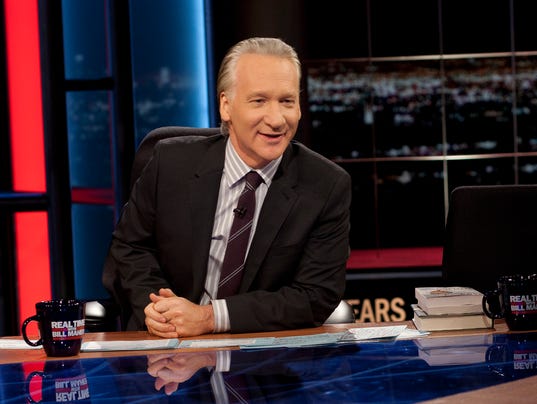
And the late-night comics? Well Bill Maher called her hypocrite. Why? It turns out Davis, who has been fighting so hard for traditional marriage, has had some marriage problems of her own.  Maher analyzes Davis' history, and gives a more practical explanation for her inability to issues licenses in today's Punchlines.
Take a look at our favorite jokes in the video above, then vote for yours in the quick poll to the right.  Watching from your smartphone or tablet? Then visitopinion.usatoday.com to cast your ballot.
Listen to the podcast!
On the go today? No time to stop and watch the video? No problem.  We've got you covered.  Click or download below for the audio version!
Read more »

Wolff: Ad blockers impair digital media


Ad blocking, traversing through the denial, anger, bargaining, depression and acceptance stages of Internet grief, has come. Software can strip out tiresome search, banner, pop-up and video ads — and, hence, the lion’s share of digital media revenue.
There have been various ways of seeing this as someone else’s problem: a European problem, where much of the software has been developed; an ad industry problem for not making ads more engaging; and even a software problem in which blocking software itself needed to be blocked. But with Apple’s move to supply ad blockers with iPhones and Safari, it now has become everybody’s problem or, most specifically Google’s problem, or, simply, an idea whose time has come. Technology disrupts technology.
The fundamental premise of consumer advertising, and of the traditional media business, is of course that ads are unavoidable. As fundamental a premise is that if people can avoid advertising, they do. And further: As soon as they do figure out how to circumvent advertising, they don’t go back to it.
Before the Internet was a threat to television advertising, the DVR already was. Or, as soon as home video gave everybody a taste of TV without ads, then there was only going forward to a world without them. Now, in a once-unimaginable development, you can watch as much television as you want without seeing any advertising ever. There is a new television audience that would not know what to do with the discordant interruptions of ads (except pay more to get rid of them). And this non-ad audience, an audience that can afford to pay for not seeing ads, is the one, precisely because they can pay, most sought after by advertisers.
In a peculiar parallel universe, there has recently been enormous digital merriment about the steep fall in traditional television stocks, and the description by a well-known analyst of the television industry as “structurally impaired.”
In part this impairment is the result of viewers theoretically leaving traditional television, thereby cutting the value of television advertising, in a flight to digital, which is expected in total dollars to surpass television ad spending by 2016.
But, curiously, the television industry, seeing the threat to its advertising bread and butter, began a long conversion from being wholly ad supported to now deriving 50% of its revenues from subscription and licensing fees.
Read more »

Jumat, 11 September 2015

Chip Kelly's field-goal indecision cost the Eagles a chance to win on 'Monday Night Football'


Chip Kelly’s decision to try for a 44-yard field goal with just under three minutes remaining in the Philadelphia Eagles 2015 debut wasn’t the problem. Yes, you’d think if there was one NFL coach who would might have gone for fourth-and-1 on his opponent’s 26-yard line while down two points, it’d be Kelly, particularly with how well his offense was moving in the second half. But there are certainly merits to keeping all your timeouts and going for a fairly easy field goal that would have given his Eagles a one-point lead. While not the wild-card move you’d expect from the freewheelin’ Chip Kelly, it was a perfectly reasonable play call.
No, the problem was that Kelly took far too long in deciding it. The indecision caused a rushed snap, hold and kick. It didn’t mean Cody Parkey’s boot was going to miss, but it didn’t help it.
Ryan Mathews was stuffed on third-and-1 with 3:08 left in the game. The 40-second play clock started immediately. Tick, tick. The offense lingered on the field. Sam Bradford looked toward Kelly, like he was expecting the “go for it” signal from the sideline. Tick, tick: Ten seconds had already elapsed. There were 30 seconds on the play clock.

Kelly conversed with special teams coach Dave Fipp and his kick unit. The coach moved his arms back and forth in an indecisive way, clearly unsure of what to do, even though it now appeared he’d kick the ball to take the lead. Tick, tick. At 27 seconds he seemed to make the decision to send on the field-goal unit, but he wasn’t sure about it. Confusion reigned. Tick, tick. At 23 seconds, the six-man unit finally starts its jog onto the field for the kick.
Tick, tick: The unit passed Bradford and his receivers, still quite close to the Eagles sideline with 19 seconds on the play clock. There wasn’t much rush. At 13 seconds, Parkey took his first warm-up kick, like a golfer stretching out with a waggle on the opening tee. At 10 seconds, he started marking off his distance while holder Donnie Jones got in position. Tick, tick.
It wasn’t until five seconds were left on the play clock that Parkey got fully set, though watching live it was clear he wasn’t comfortable. With three seconds left, the ball was snapped and it was wide-right immediately off the foot.
Read more »

A Dekade Before Filmmakers


A decade before filmmakers migrated to Hollywood, they'd already figured out that the Caribbean was a nice place to get away from the dreary winter and gray skies that afflicted their studios in New York and New Jersey.
Thomas Edison patented and popularized the motion-picture camera in 1891, though, as with the light bulb, he didn't actually invent it. His company did produce what may be the first motion-picture set in the Caribbean, West Indian Girls in Native Dance, filmed on St. Thomas in the winter of 1903. It features a bevy of West Indian beauties doing the shay-shay in a garden in Charlotte Amalie. That same year, the company issued another epic filmed in the Bahamas titled Native Woman Washing a Negro Baby in Nassau, B.I.. The Caribbean had been "discovered" all over again, and they've been making movies here ever since.
The following highlights are far from inclusive and ignore the many direct-to-video and television productions shot in the region.
DR NO
1962 | Sean Connery, Ursula Andress
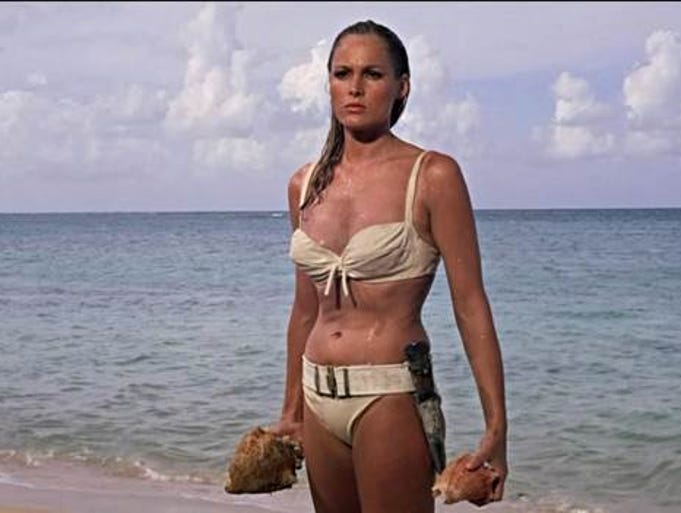
The first James Bond film finds Ian Fleming's hero on a mission to Jamaica to investigate the mysterious death of a British intelligence agent. Along the way he meets CIA agent Felix Leiter (Jack Lord) and the glamorous Honey Rider (Andress). It was the Swedish bombshell's entrance — she appears from the ocean at Laughing Waters Beach in front of Dunn's River Falls wearing a white bikini — that set the standard for all of the "Bond Girls" who followed. Andress reportedly auctioned off the bikini for more than $60,000.

HELP!
1965 | John, Paul, George and Ringo
The beach scenes for the follow-up to the Beatles' first film, A Hard Day's Night, were filmed on Paradise Island off of Nassau. The movie was under-appreciated for years, even by the Beatles themselves, who attributed their manic performances to "smoking a lot of marijuana" during the production. Nonetheless, "Help!" did feature some of their best early tracks including Ticket To Ride, Another Girl and, of course, Help!
SHAWSHANK REDEMPTION
1994 | Tim Robbins, Morgan Freeman
The grim prison movie adapted from horrormeister Stephen King's novel ends on an up note, when ex-cons Andy (Robbins) and Red (Freeman) are reunited on a paradise-worthy beach in Zihuatanejo, Mexico — or not. The scene was actually shot at Sandy Point on the southwest end ofSt. Croix, USVI.
DR. DOOLITTLE
1967 | Rex Harrison, Samantha Eggar, Richard Attenborough
If your familiarity with the Dr. Doolittle story is confined to the 1998 Eddie Murphy remake, pull up your Netflix account and take a look at the original. Predictably, it's more naive but also much more charming. The scene where the good doctor (Rex Harrison) talks to the giant pink snail was filmed in Marigot Bay, St. Lucia.
TRADING PLACES
1983 | Eddie Murphy, Dan Aykroyd, Don Ameche, Ralph Bellamy
In Murphy's Doolittle remake, he never made it any farther from Hollywood than San Bernardino and San Francisco. However, he definitely made up for it when he and Dan Aykroyd filmed "Trading Places." The final scenes that show the two enjoying their new-found wealth — fleeced from "brothers" Don Ameche and Ralph Bellamy — were filmed in St. Croix.
Read more »
Kamis, 10 September 2015

Giants thrown for loop by Eli Manning telling Rashad Jennings not to score


Though New York Giants coach Tom Coughlincontinues to take responsibility for a catastrophic collapse in Sunday night’s 27-26 loss against the division-rival Dallas Cowboys, he made it clear that someone else was to blame: quarterback Eli Manning.
During a conference call with reporters, the Giants confirmed that running back Rashad Jennings had been instructed not to score late in the game when the Giants held the ball near Dallas’ goal line with a three-point lead.
“That was not instructed from the sidelines,” Coughlin said Monday during the call. “In talking with Eli today, I think he was confused by the number of timeouts that were remaining. His intention was, with one timeout, that we would milk the clock as best we could. However, they had two timeouts left.”
Coughlin later added: “My intent was to be up 10.”
With the ball on the 4-yard line and just fewer than two minutes to play, the Giants handed the ball off to Jennings on first and second down. Jennings told ESPN in an interview that on one of the plays, he “cut the wrong way [on purpose] and found somewhere soft to fall” in order to follow Manning’s directions.
“I thought they only had one timeout,” Manning said during the call. “I told Rashad, ‘If they let you score, go down at the 1-inch line.’ ”
Before the second down play just seconds later, Manning went to the sideline and informed the Giant coaches about what he told Jennings. When he returned to the huddle, the instructions were the same.
“I thought we were on the same page and I was wrong,” Manning said. “That was my mistake.”
That wasn’t Manning’s only one.
On the next play, a crucial third-and-goal from the 1-yard line, he took a play action snap and retreated to avoid Dallas’ pass rush, before eventually throwing the ball out of bounds. The clock stopped with 1:43 left in the game. Rather than to take a sack, Manning’s incompletion saved Dallas about 40 seconds.
Read more »

Rabu, 09 September 2015

Bell: Without Dez and DeMarco, Cowboys' Tony Romo can finally prove MVP worth


For a split second, it looked like another dose of disaster to fuel the haters.
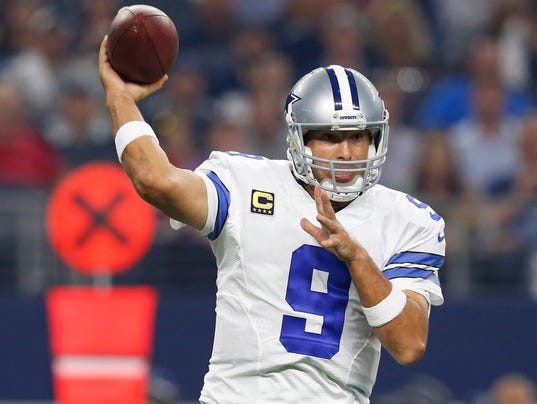
The snap was low, in the turf. But with the game — and a miraculous comeback on the line in the waning seconds Sunday night — Tony Romo didn't flinch.
Instead, the most scrutinized quarterback in America calmly scooped up the football, regained his rhythm, set his feet and fired the game-winning touchdown pass over the middle to his most trusted target, tight end Jason Witten.
It was also a clear snapshot of how the Dallas Cowboys might survive in the coming weeks without their most dangerous weapon. Yes, Romo will have to get it done.
Dez Bryant's tweet later in the night said it all: "I'll be back soon but how about 9????????"
That would be Romo, No. 9, who suddenly has added layers of adversity and responsibility on his plate while Bryant rehabs from surgery for a broken bone in his foot.
What a sudden identity shift for the Cowboys. But that's the NFL — a fire here, a flood there. Adapt or else.
When the Cowboys head to Philadelphia this weekend for an early showdown to determine NFC East supremacy, the running back who took so much pressure off Romo by winning the rushing crown last season, DeMarco Murray, will be lining up for the hated Eagles. And the receiver who torched the since-overhauled Eagles secondary for three touchdowns in the December game at the Linc that essentially determined 2014 the division crown will be home with his foot in a cast.
So now it's on Romo to keep his team moving.
No doubt, he's well-equipped on multiple levels. Since he became a starter in 2006, no quarterback in the NFL has directed more game-winning touchdown drives. The march Sunday night, aided by New York Giants blunders (the Cowboys were out of timeouts) that left Romo extra time to work his magic, marked his 28th such victory drive.
He's also equipped to handle the upcoming grind mentally. Romo has had some last-minute mishaps over the years, which his detractors cite to suggest he can't win the big one. But in reality, he gets a bad rap. More often than not, as demonstrated against the Giants, Romo is clutch.
It's tough to imagine that he can be under the microscope any more than he has been while playing for arguably the most high-profile team in the NFL. But it's possible. Over the next few weeks, Dallas needs Romo to excel with the no-name targets flanking Witten. That's what the great ones can do for a team, and Romo has been there before.
Read more »

Selasa, 08 September 2015

New Jersey man arrested and charged with conspiring to support ISIS

A former New Jersey resident has been arrested and charged with allegedly conspiring and attempting to provide support to the Islamic State, the U.S. Department of Justice said Monday.
Nader Saadeh, 20, a former Rutherford, N.J., resident, was expected to appear before a federal judge Monday afternoon.
The charges against Saadeh stem from an FBI investigation into a group of individuals from the New Jersey-New York area. Saadeh is the sixth man to be arrested in the two-state sting. His brother, Alaa Saadeh, was arrested on June 29.
Federal investigators say Saadeh sent “electronic messages” between 2012 and 2013 that expressed his anger and hatred for the United States. At that time, he also expressed interest in forming “a small army” that would include his friends. He also, reportedly, posted images of the black and white ISIS flag on his Facebook page in 2014.
According to an informant working with the FBI, Saadeh told friends in April 2015 that he was preparing to travel overseas. It was around that same time authorities say Saadeh became a “radicalized supporter” of ISIS and expressed solidarity with those behind the terror attacks in Paris. In that attack, 12 people were killed at the offices of Charlie Hebdo, a French satirical magazine that published controversial cartoons about the prophet Muhammad.
The investigation into Saadeh started when a friend, identified as “individual 1” in court documents, contacted the FBI and expressed concern that Saadeh, his brother and their friends were planning a trip overseas where they might join a terror group.
Individual 1 told investigators that Saadeh’s interest in ISIS as well as his “adoption of stringent religious behavior” coincided with other statements he made in support of ISIS.
Investigators say they also obtained emails from April 2015 that were sent to Saadeh by family members, including one from his mother, begging her son not to join the terror group.
A third New Jersey resident, Samuel Rahamin Topaz, was arrested on June 17, 2015. Topaz was also charged with conspiring to provide material support to ISIS.
In a post-arrest interview, Alaa Saadeh, told authorities his brother Nader and Topaz watched ISIS propaganda videos together and discussed going overseas to join the group.
Saadeh, a dual U.S.-Jordanian national, got on a May 5 flight from New York to Amman, Jordan. He was detained upon arrival, though it was not immediately clear when he was returned to the United States.
If Saadeh is found guilty, he could face up to 20 years in prison and a fine of $250,000.
Read more »